
Author: The Symtive Team
There's a brutal truth hiding inside most corporate training programs: the moment your employees walk out of the classroom, they've already started forgetting what you just taught them.
This isn’t a theory. It’s a 140-year-old scientific finding that most organizations still haven’t figured out how to solve.
The Curve That Should Keep Every L&D Leader Up at Night
In the 1880s, German psychologist Hermann Ebbinghaus conducted a series of painstaking experiments on himself, memorizing lists of nonsense syllables and then measuring how quickly he forgot them. What he discovered became one of the most replicated and sobering findings in all of cognitive science: the Forgetting Curve.
The data is stark:
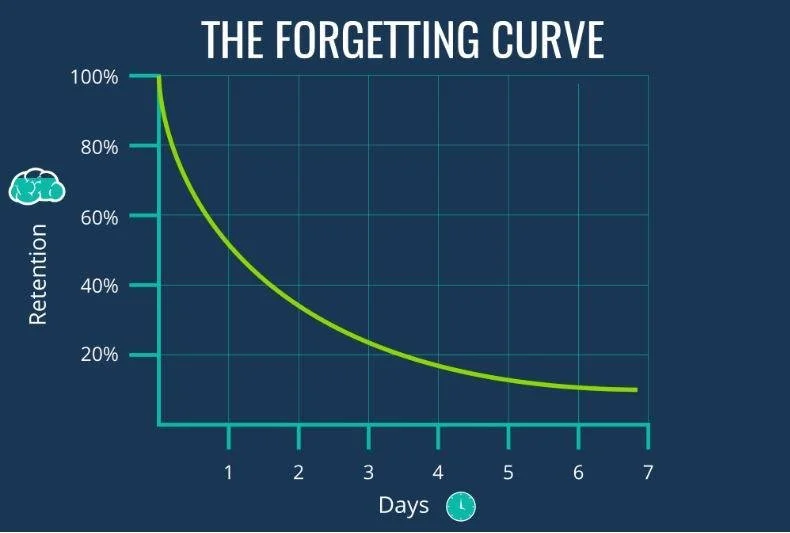
Hermann Ebbinghaus - Forgetting Curve
· Within 24 hours of learning something new, people forget approximately 70% of it
· Within one week, that number climbs to nearly 90%
· Without reinforcement, almost everything from a single training session eventually fades to nothing
Let that sink in for a moment. You invest in instructors, training materials, facility time, and employee hours and by tomorrow morning, most of it is gone.
Ebbinghaus didn't just describe the problem. He also identified the solution: spaced repetition and active recall. The more times the brain retrieves a memory, especially across spaced intervals, the stronger and more durable that memory becomes. He called this the "spacing effect," and it remains one of the most robust findings in learning research.
The question is: why, more than a century later, are most industrial training programs still designed in ways that guarantee forgetting?
Why Traditional Training Is Fighting a Losing Battle Against Your Brain
The typical enterprise training model looks like this: gather workers in a room (or in front of a screen), deliver information, hand out a completion certificate, and move on. Maybe there's a quiz at the end. Maybe there isn't.
This approach has three fundamental problems when measured against what neuroscience actually tells us about learning.
Problem 1: Passive consumption doesn’t build durable memories.
The brain prioritizes information that requires effort to retrieve. When a learner passively watches a video or reads a slide, the neural pathways formed are shallow. There's no struggle, no active retrieval, and therefore no signal to the brain that this information matters enough to keep. Cognitive scientists call this the "desirable difficulty" principle, we learn more from things that require effort, not less.
Problem 2: One-and-done delivery guarantees decay.
Ebbinghaus showed us that a single exposure, no matter how well-delivered, loses the war against forgetting. Retention requires repeated retrieval spaced over time. A four-hour training session followed by nothing is scientifically designed to fail.
Problem 3: There are no consequences in traditional training.
When a worker watches a video about lockout/tagout procedures, nothing happens if they zone out. When they sit through a compliance slide deck, there's no feedback loop between what they're doing and what they should be learning. The brain doesn't encode "this is important" because in the moment, there are no stakes.
What the Brain Actually Needs to Learn
Before we talk about how simulation solves the forgetting problem, it helps to understand what the brain needs to form durable, usable memories.
Brain
Research in cognitive neuroscience points to three key ingredients:
Active engagement. The learner must do something, not just receive information. Motor actions, decision-making under pressure, and problem-solving all trigger stronger encoding than passive listening.
Emotional stakes and feedback. When an action leads to an outcome, especially an unexpected or consequential one, the brain pays attention and encodes the experience more deeply. Dopamine, the brain's reward signal, plays a major role in consolidating memories.
Spaced retrieval. Returning to the same content multiple times, with gaps in between, dramatically strengthens retention. Each retrieval act reinforces and expands the neural pathways associated with that memory.
Traditional training struggles to deliver any of these reliably. Simulation delivers all three by design.
How 3D Interactive Simulation Rewires the Learning Experience
At Symtive, we build browser-based 3D training simulators that mirror the actual equipment, environments, and procedures your workforce encounters on the job. And when we look at the forgetting curve research, we see exactly why simulation is so effective at defeating it.
Simulation demands active engagement.
There is no passive mode in a Symtive simulator. The learner is operating equipment, making decisions, following procedures, and responding to system feedback in real time. Every interaction requires retrieval and application, exactly the kind of effortful processing that builds durable memory. The brain is not watching. It is doing.
Simulation creates meaningful consequences.
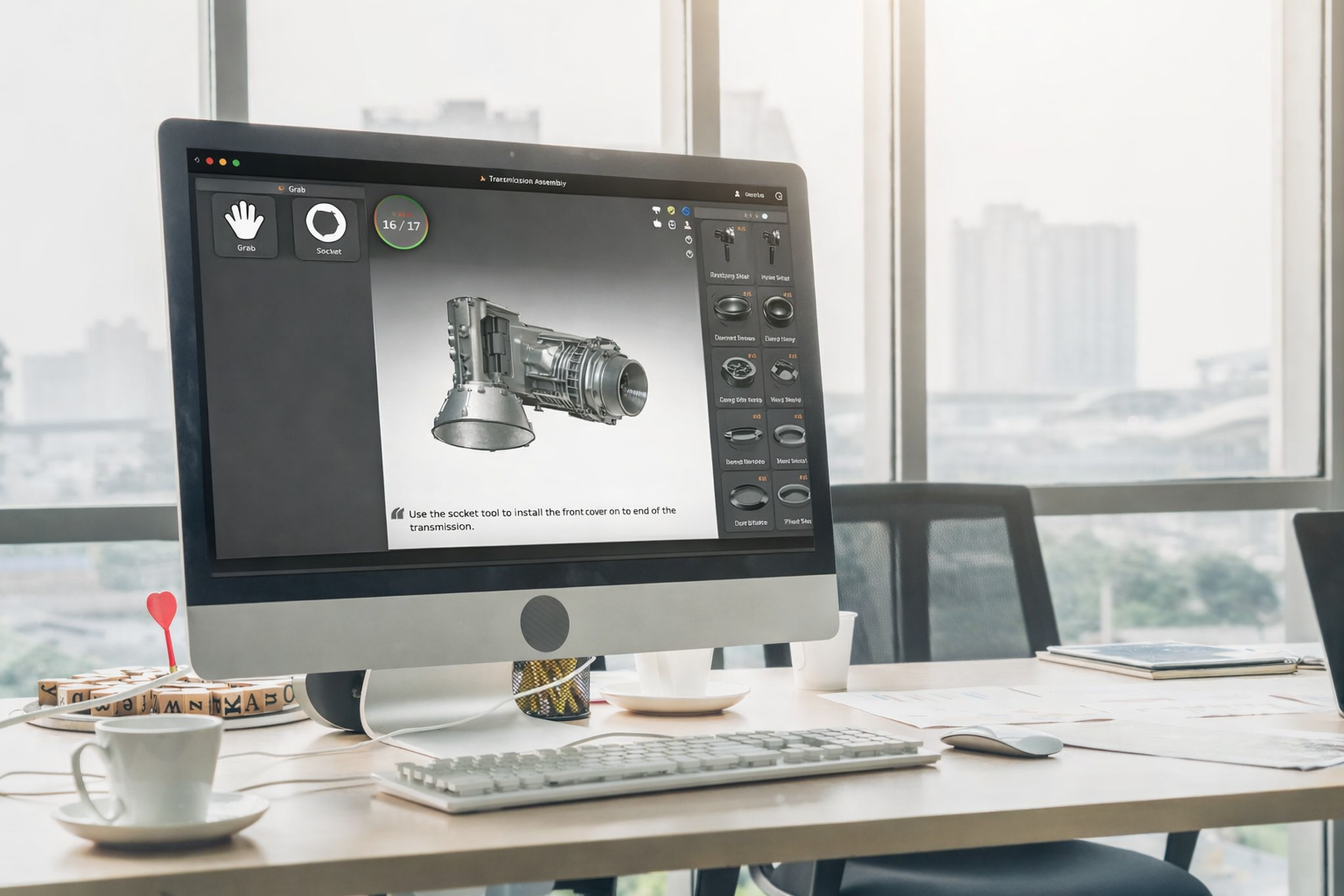
How 3D Interactive Simulation Rewires the Learning Experience
When a technician makes an incorrect sequence in a simulator, say, skipping a step in a maintenance procedure, something happens. An alarm triggers. A system fails. The simulation provides immediate, contextual feedback. This feedback loop is neurologically powerful: it tells the brain this matters, which triggers the encoding mechanisms that passive training never touches.
Simulation enables spaced repetition at scale.
Because Symtive simulators are browser-based and require no special hardware or scheduling, workers can return to a simulation for a 15-minute refresher session one week after initial training, again before a critical procedure, and again during annual recertification. This is spaced repetition made operationally practical. The spacing effect doesn't require a classroom; it requires access, and browser-based simulation makes access effortless.
Simulation builds procedural memory, not just declarative memory.
There are two kinds of knowledge: knowing that something is true (declarative) and knowing how to do something (procedural). Reading about a procedure creates declarative memory. Performing that procedure, even in simulation, begins building procedural memory. This is the same mechanism by which musicians develop muscle memory and surgeons develop dexterity. Repetition in simulation doesn’t just remind workers what to do. It trains the body and mind to do it automatically.
The Compounding ROI of Better Retention
The forgetting curve isn't just a learning science problem. It's a financial and safety problem.
When workers forget critical procedures, the consequences show up in:
· Increased error rates and rework on the production floor
· Longer time-to-competency for new hires who need repeated retraining
· Safety incidents rooted in procedures that were “trained” but never truly learned
· Audit failures when workers can’t demonstrate competency, they were certified for months ago
Simulation changes this calculus entirely. When training results in durable retention, the downstream costs of forgetting, retraining, incidents, errors, and rework decrease significantly. The ROI of simulation isn’t just about replacing instructor time. It’s about the compounding value of a workforce that actually retains what it learns.
The Practical Takeaway for Training Leaders
Ebbinghaus gave us the map more than a century ago. The forgetting curve tells us exactly what we're up against, and the spacing effect tells us exactly how to fight it. The missing piece, for most of the last hundred years, has been a training format that could deliver active, consequential, spaced learning at an industrial scale.
That's what 3D simulation does.
If your organization is investing in training that workers forget before their next shift, the problem isn't your content or your instructors. The problem is the format. A single exposure, passively consumed, will always lose to the biology of forgetting.
Simulation doesn't fight the forgetting curve. It's built to beat it.
Ready to see how Symtive simulators are helping enterprise teams across automotive, aerospace, defense, and manufacturing to build retention that lasts? Explore our simulations
Symtive creates custom, browser-based 3D training simulators optimized from complex CAD files, serving enterprise clients across automotive, aerospace, defense, medical, and industrial manufacturing industries. Our simulators require no headsets, no installs, and no special hardware, just a browser and a commitment to training that works.